EberronSpace is a universe loosely connected to ArcaneSpace by a portal in the Radiant Triangle (KrynnSpace, RealmSpace and GreySpace). It is a Material Plane encompassing a globular cluster containing several stellar systems, one of which is the Eberron System, which consists of one sun, one planet with a ring and 12 moons, though history says there were once 13...
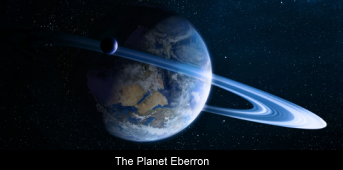
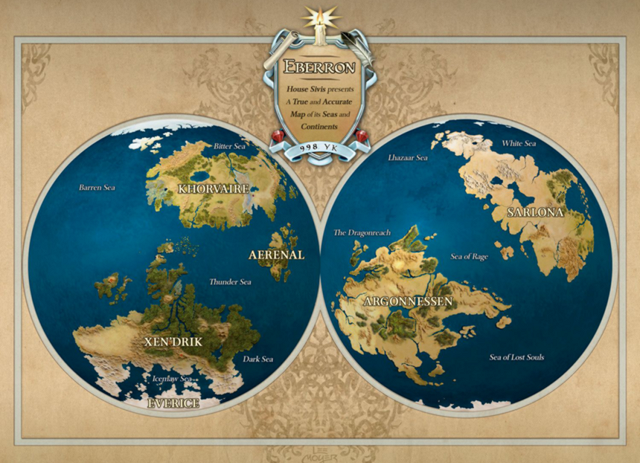
The world of Eberron contains seven continents. Khorvaire is the most populated continent. Humans are the most populous race in Khorvaire, living primarily in the area known as the Five Nations. Southeast is the small continent of Aerenal, ruled by elves. Due south is the jungle continent of Xen'drik, once ruled by an empire of giants that collapsed. It is now largely wilderness, with some areas under tribal dominion of the drow. Further south of Xen'drik is Everice, a continent-sized sheet of ice possibly covering several land masses. Frostfell is an unexplored land of ice in the north. The other two main continents are Sarlona (a continent ruled by quori, creatures from the Region of Dreams) and Argonnessen (a continent inhabited by dragons). The world of Eberron has twelve moons; some sages believe there is a thirteenth moon that has vanished or is invisible to the naked eye.

The Last War was a conflict that raged between Aundair, Breland, Cyre, Thrane, and Karrnath. Its purpose was to reunite the Kingdom of Galifar after the conflict over succession that started upon the death of King Jarot in 894 YK. The conflict lasted over a century and ended with the signing of the Treaty of Thronehold in 996 YK.

- The Treaty of Thronehold officially ended the Last War. The treaty recognized the following nations as sovereign states: Aundair, Breland, Darguun, the Eldeen Reaches, Karrnath, the Lhazaar Principalities, the Mror Holds, Q’barra, the Talenta Plains, Thrane, Valenar, and Zilargo. These nations abide by a common set of laws and maintain diplomatic relations. The Demon Wastes and Shadow Marches regions have no unified government. Droaam has declared itself a nation but has yet to be recognized by the treaty nations.


- Khorvaire is found in Eberron's northern hemisphere. It is bounded by the Bitter Sea to the north, the Lhazaar Sea to the east, the Barren Sea to the west, and the Thunder Sea to the south. The landscape of Khorvaire varies greatly, from wastelands and forbidding mountains in the north to deserts and jungles in the south, with everything in between.
Khorvaire is a large continent with many nations and autonomous regions. The borders of many of these areas are disputed, despite having been determined in the Treaty of Thronehold. The major nations and regions of Khorvaire are Aundair, Breland, Karrnath, Thrane, and the Mournland (formerly known as Cyre).


- Sharn is the most populous city in all of Khorvaire, and arguably all of Eberron. The city literally towers atop a cliff above the mouth of the Dagger River in southern Breland. Sharn is known as the City of Towers, but has also been called many other names, including the City of Knives, the City of Lost Souls, the City of a Thousand Eyes, the Gateway to Xen'drik, and the Gateway to Perdition.
The city now known as Sharn was built upon a foundation that dates back thousands of years before humans ever settled Khorvaire. During that time, the goblinoid Dhakaani Empire's greatest city was carved into the jagged cliffs that Sharn now towers over. This city was called Ja'Shaarat. This metropolis didn't rise toward the skies, like Sharn does. Instead, the architects of the Dhakaani built a vast number of chambers and tunnels into and under the ground. As the city grew in size, the Dhakaani eventually built great monolithic buildings on the plateaus above the Dagger River that would later serve as the foundations for Sharn. When the daelkyr invaded Eberron, the city was devastated, and the goblins never had a chance to restore it to its greater glory.
Thousands of years later, when human settlers from Sarlona began to explore Khorvaire, they stumbled upon the Dagger River. The river led Malleon the Reaver and his explorers to the site where Ja'Shaarat once stood. There he enslaved what goblins still resided in the ruins and erected a fortress there. He sealed off the lower wards of the ancient goblinoid city and named the city Shaarat, as a result of stories told by the goblins he enslaved. For 600 years, Shaarat prospered and grew into a powerful metropolis once again. Breggor Firstking, the first ruler of what would become Breland, eventually conquered Shaarat and renamed it Sharn.
Over the course of the next 800 years, Sharn's towers began to rise and the city developed into something resembling Sharn today. Around this time, the dragonmarked houses began to prosper and this helped cultivate Sharn into an economic power. But the dragonmarked houses also brought with them War of the Mark. The leader of those who bore the aberrant dragonmark, Halas Tarkanan, took control of Sharn and turned it into a home for all who wore the destructive marks.
Tarkanan couldn't hold the city for long, but in the end he used his terrible powers to destroy much of the city. For the next 500 years, the city was looked down upon and the city remained in ruins. Then, when Galifar I took control of the Five Nations he rebuilt Sharn. The metropolis felt the blessings of Galifar and eventually developed into the center for trade, diplomacy, and intrigue that it is today.
Sharn looms atop the cliffs overlooking the Hilt, a bay at the mouth of the Dagger River in southern Breland. The city sits upon the foundation of an ancient goblinoid city. Below that, a rumored lake of molten lava rests, but its presence can be felt only in the lowest parts of Sharn, the Cogs.
The inhospitable outcropping that Sharn sits on allows the city to grow only in vertical height. This might have been a problem for other cities, but Sharn happens to be located within a manifest zone linked to the plane of Syrania, the Azure Sky. The manifest zone enhances magic that creates flight and levitation. This allows Sharn to have towers that rise nearly 1 mile (1.6 kilometers) in height, transportational flight, and even a section of the city that floats above the highest towers.
Sharn is a vertical city. It is divided up into five distinct plateaus: Central Plateau, Menthis Plateau, Northedge, Dura, and Tavick's Landing, as well as the Cliffside district built into the sides of the cliff near the Dagger River. While each plateau divides the city into districts, the city is also stratified vertically and divided into several sections. The lowest wards of the city are called the Cogs, and if one were to walk to the heights of Sharn they would pass through the Depths, the Lower City, Middle City, Upper City, and then finally they would need to find some method of travel to the highest section of Sharn, which is Skyway. Generally, the higher one is in Sharn, the wealthier the citizens are. Each section of the city is further divided into smaller districts.
- Central Plateau
- A largely upper and middle class district in the middle of the city, Central is the center of government where the city government and embassies from other nations are located. It is also home to some of Sharn's finest businesses, banks, and wealthiest citizens.
Menthis Plateau
The trendiest of Sharn's plateaus, Menthis is an entertainment hub and popular tourist destination. It is also home to Sharn's Morgrave University on the upper level.
- Northedge Plateau
- Northedge is a relatively quiet, largely residential plateau.
- Dura
- Dura is the largest and poorest plateau, with only the Cogs being worse off. A mixture of residential and business districts, it is also home to the widest variety of peoples.
- Cliffside
- Cliffside is built into the side of the cliffs along the Dagger and Hilt Rivers. Its businesses all catered to either shipping or adventuring interests.
- Tavick's Landing
- Tavick's Landing, located at the eastern edge of the city, is defined by being the terminus for the lightning rail.
- Skyway
- Skyway is but a single district, not connected to any plateau but rather suspended by magic above the rest of the city (a magic that only worked because of the manifest zone). Skyway is the home of the most fantastically wealthy and prestigious residents, as well as businesses that attended to them.
- The Depths
- The Depths is the generic name for the regions below the main plateau, excepting the Cogs and Cliffside. Largely a system of sewers and ruins.
- The Cogs
- The churning industrial heart of Sharn, located below the Depths along the chasms that divided Sharn's plateaus.

As is common to many universes within what is known as Arcane Space, the Planet Eberron has a plethora of sapient species. One of these which seems ubiquitous is what the Federation recognises as baseline humanoid, or Human. Humans are interfertile with many of the other species, notably Elves and Orcs, producing Half-Elves and Half-Orcs respectively.
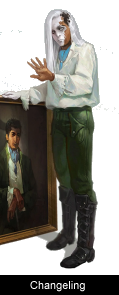
- Changelings
- Changelings are a humanoid race who are distantly descended from doppelgangers and share their shapeshifting qualities. Their shapeshifting has led to them being used as spies and assassins, which has, in turn, led to them being mistrusted amongst the people of Khorvaire.
- Doppelgängers
- Doppelgängers are monstrous humanoids infamous for their innate shapeshifting abilities, which allow them to mimic almost any humanoid creature.
- Dwarves
- Dwarves are natural miners and smiths, and they control most of the precious metals found naturally across the continent of Khorvaire. Powerful dwarf families mint coinage and operate banks, issue letters of credit, hold loans, and collect debts. Dwarf bankers and merchants wield a great deal of economic power throughout Khorvaire, and they are well respected as a result. To an extent, they are also feared, since dwarves are known to be ruthless in collecting unpaid debts.
- Elves
- Elves originated in Xen'drik during the Age of Giants, where they were slaves of the Giants. Modern elves are split into many distinct cultures: the Aerenal, the Valenar, the Khorvaire elves, and the Drow of Xen'drik.
- Aerenal - The Aerenal elves worship their ancestors as Deathless, lifeforms much like undead but kept alive by the positive energy of Irian. The Deathless serve as advisors and defenders and are considered by those who worship them to be divine as a whole, in the form of the Undying Court.
- Drow - The Drow of Xen'drik don't worship their ancestors directly. Rather, they tend to hold to the preservation of their forebears' traditions. They believe nothing honors their ancestors more than by living as they did.
- Khorvairean - The elves of Khorvaire are as diverse as the elf race as a whole. They divide themselves by nation or by dragonmarked house and often follow the local customs. A few still hold their own race's beliefs in ancestor worship, but not to the same degree as the tairnadal or aereni. Currently, there is one elven dragonmark present in Khorvaire - the Mark of Shadow. it is divided across two houses: House Phiarlan and House Thuranni.
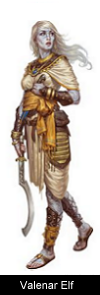
- Valenar - During the Last War, elves of the Valaes Tairn were used by the nation of Cyre as mercenaries. In 956 YK these elves, under the leadership of War Leader Shaeras Vadallia, turned on their Cyran employers, conquering a large region of southwestern Cyre. Vadallia crowned himself High King and founded the nation of Valenar. However, much of the population of Valenar is still made up of former Cyrans, with elves making up less than half of the total population.
- Half-Elfs - Half-elfs are one of the common races. They descend from elves and humans but have since become a race distinct from both their elven and human ancestors. Half-elves refer to themselves as Khoravar and are found throughout the continent; they are not concentrated within a specific geographic region.
- Gnomes
- Gnomes are among the most inquisitive of races. They seek knowledge in all its forms and tend to careers which allow them to fulfill this thirst: bards, historians, alchemists, and librarians, as well as spies. The gnomes rule the nation of Zilargo, one of the oldest nations of Khorvaire.
- Goblinoids
- On Eberron, several goblinoid races are known to exist with goblins and hobgoblins among the most common. There are three primary types of goblinoids:
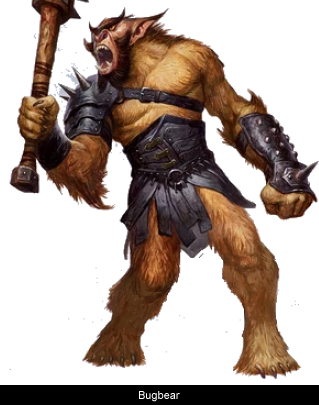
- Bugbear - Also known as Guul'dar or "strong people" in the Dar language. Largest of all the goblinoids, bugbears tend to be more physical and aggressive than their smaller kin.
- Goblin - Also known as Golin'dar, or "quick people" in the Dar language, they are the smallest and most numerous goblinoids, for which the subtype is named due to human misunderstanding.
- Hobgoblin - Also known as Ghaal'dar, or "mighty people" in the Dar language, hobgoblins are a race of lawful (a rarity amongst goblinoids) yet aggressive goblinoids who are larger than goblins yet smaller than bugbears, standing roughly the same height as most humans. Hobgoblins were once the rulers of the great Dhakaani Empire that fell several ages ago.
- Halflings
- The halflings of Eberron vary from nomadic dinosaur-riding barbarians to wily urban merchants and professionals. With the broad expanse of the Talenta Plains, the shelter of urban havens spread across Khorvaire, and the potency of House Jorasco and House Ghallanda, the halflings are as widespread as any other race across Khorvaire.
- Talenta - The halflings of the Talenta Plains maintain the traditions of their ancestors, including tribal masks and dinosaur mounts. Though physically the same as urban halflings, the Talentas strike a much more imposing figure. Rarely in one place for long, the nomadic tribes traverse the Talenta Plains moving with the herds they hunt for food.
- Khorvairean - Some halflings traded the nomadic lifestyle of the Talenta halfling for a more urban approach, living in major cities across Khorvaire. While many of these halflings are associated with one of the two dragonmarked houses, some are simply independent halflings wanting something different for their lives. Some urban halflings have never seen their native homeland, while others (mostly those associated with the dragonmarked houses) switch between city clothes and nomadic traditions depending on where they find themselves.
- Humans
- Humans have inhabited Khorvaire for millennia. They dominate the land, but in some ways they are relative newcomers to the continent. Most humans don't spend time contemplating their race's origins, and many do not even know that they are not native to Khorvaire, but history does not lie: Humans came from Sarlona.
- The Inspired
- The Inspired are a race of beautiful humans from the continent of Sarlona who rule the Unity of Riedra. They are said to be descended from some mixing of human, elvish, and fiendish blood. The Inspired are Chosen vessels that have been possessed by a quori spirit. Ruling over the ever-expanding nation of Riedra in Sarlona, the Inspired have slowly begun expanding into Khorvaire, starting to make trips to its eastern shores.
- Kalashtar
- Being the combination of humans who willingly fused with quori souls, kalashtar look much like humans, having the same ranges of eye, hair, and skin colors. Kalashtar are commonly tall and slim, though kalashtar of all sizes exist. The only real difference in kalashtar is their monastic behavior.
- Orcs
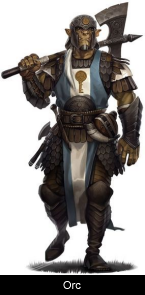
- Orcs are large and powerful humanoids who can be found across Khorvaire, but particularly in the Demon Wastes, the Mror Holds, and the Shadow Marches. While the people of the Five Nations sometimes depict them as savage brutes and ravaging barbarians, most orcs are in fact a deeply spiritual people with a variety of different cultures across the continent.
- Half-Orcs - The half-orcs are originally progeny of human and orc procreation, though half-orcs can mate with either species and create half-orc children. Half-orcs occupy the fringe of society.
- Shifters
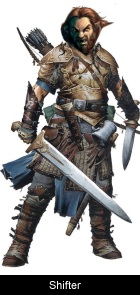
- Shifters are one of the intelligent races inhabiting Eberron. With both humans and lycanthropes among their distant ancestors, shifters posses just a small portion of their forefathers' shape-shifting abilities. They cannot transform wholly into an animal but can instead shift parts of their body to become animal-like for short periods of time.
- Warforged
- Born from the strife of the Last War, the Warforged remain as constant reminders of that terrible time. To look upon one is to see an instrument of destruction, a heartless killing machine, a siege engine in the shape of a man. Despite the purposes for which House Cannith built them, however, Warforged can choose to be peaceful. When given thinking minds, Warforged were granted the ability to surpass the limited uses for which their creators had designed them.

- Magic is the lifeblood of the world of Eberron. From elemental transports, to artificer infusions, to dragonmarked houses to psionics, magic has many forms and all forms are employed to maximum efficiency in the world of Eberron. The magewright testifies to the concept of magic being so prevalent that it's as much a trade as blacksmithing and bookbinding.

In mythology, Eberron is also the name for the land of the world, and is referred to as the Dragon Between. Siberys, the Dragon Above, is the name given to the planetary rings which surround the planet. Khyber, the Dragon Below, is the name given to the underworld, and is similar to the Underdark in many other settings. According to the creation story, the world was formed when the progenitor wyrms changed their form into what they are now. Siberys and Khyber fought, leading to Siberys' body being broken into pieces. To stop Khyber, Eberron wrapped around him, and Siberys' broken body became a ring around them both. Siberys created the dragons, Eberron created humanoids and other "lower races", and Khyber created the "demons" of the world.

|