



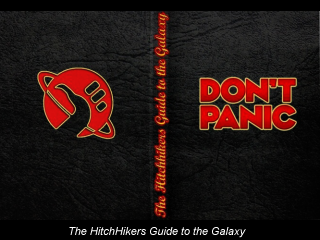
  "The Hitch Hiker's Guide has already supplanted the great Encyclopædia Galactica as the standard repository of all knowledge and wisdom, for though it has many omissions . . . it scores over the older, more pedestrian work in two important respects. First, it is slightly cheaper; and secondly it has the words DON'T PANIC inscribed in large friendly letters on its cover. "The Hitch Hiker's Guide to the Galaxy is an indispensable companion to all those who are keen to make sense of life in an infinitely complex and confusing Universe . . . where it is inaccurate it is at least definitely inaccurate. In cases of major discrepancy it's always reality that's got it wrong. . . . 'The Guide is definitive. Reality is frequently inaccurate.' "Space . . . is big. Really big. You just won't believe how vastly, hugely, mind-bogglingly big it is. I mean, you may think it's a long way down the road to the chemist, but that's just peanuts to space. Listen... "
The Guide itself is a device which resembles a largish electronic calculator and looks "insanely complicated." It has about a hundred tiny flat press buttons and a screen about four inches square on which any one of a million "pages" could be summoned at a moment's notice. It was said that the reason why it was published in the form of a micro sub meson electronic component is that "if it were printed in normal book form, an interstellar hitch hiker would require several inconveniently large buildings to carry it around in." Although the Guide is merely a resource for hitch hikers it has a distinctly flippant and exuberant tone, occasionally bordering on sarcastic. This may either be due to the voice with which the Guide spoke, or the tone with which the many articles were written. On one occasion the Guide was said to speak in a "still quiet measured voice." The Hitchhiker's Guide to the Galaxy is a "wholly remarkable book." It has been compiled and recompiled many times over many years and under many different editorships. It contains contributions from countless numbers of travellers and researchers. P It is said that Hurling Frootmig was the founder of the Guide, and established its fundamental principles of honesty and idealism before he "went bust." After many years of heart-searching and penury, Frootmig had a chance encounter with the Holy Lunching Friars of Voondoon, after which he refounded the Guide and "laid down its fundamental principles of honesty and idealism and where you could stuff them both." Following this change of heart, the Guide’s founder began to develop and explore the role of editorial lunch-breaks, which played a crucial part in the Guide’s history, since it resulted in visitors to the offices doing most of the actual work, instead of the editors. Shortly thereafter, the Guide was taken over by Megadodo Publications of Ursa Minor Beta, leading the Guide towards its first major commercial success and keeping the staff very financially sound. This positive change allowed the fourth editor of the Guide, Lig Lury Jr, to embark on extraordinary lunch-breaks, which led to him leaving his office late one morning and never returning. As he never formally resigned his editorship, all editors since Lig Lury Jr have been designating acting editors, with Lig’s desk still preserved the way he left it. In its time, the Guide became popular than the Celestial Home Care Omnibus, better selling than Fifty-three More Things to do in Zero Gravity, and more controversial than Oolon Colluphid's trilogy of philosophical blockbusters Where God Went Wrong, Some More of God's Greatest Mistakes and Who is this God Person Anyway? The Guide was seen to be a lot less lengthy and complicated than Dan Streetmentioner's book: Time Traveler's Handbook of 1001 Tense Formations. It skipped over the exhaustive topic of time travel and grammar, pausing only to note that the term Future Perfect had been abandoned since it will have been discovered not to be. Although the Guide contained at least 5,973,509 contributions, it was called "a very unevenly edited book and contains many passages that simply seemed to its editors like a good idea at the time." It was also said that "most of the actual work got done by any passing stranger who happened to wander into the empty offices of an afternoon and saw something worth doing."
 |
