



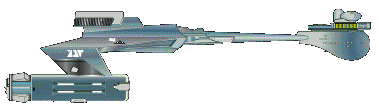
 The Klingon D7 Battlecruiser BortaS is the very stuff of legends within the Klingon Empire. Lost over a century and a quarter ago, its name has lived on, lending itself to a popular series of vids and holonovels translated into Federation Standard English as "Battlecruiser Vengeance". Under her commander, HoD Qor'tath, the BortaS had a sterling record in war and cold war against both the United Federation of Planets and the Romulan Star Empire. During the Four Years' War, the BortaS fought in over a dozen battles and was responsible for the destruction of several Starfleet vessels. In the year 2250, she undertook a secret mission to Romulus, where her crew stole the Tokath, a Vulcan artifact dating back to the time of Surak, before the Romulans left Vulcan. Romulan Birds of Prey pursued her, damaging her severely. To avoid capture or destruction by the Romulan task force, the BortaS entered Federation space and encountered the Dyson Sphere. When the Sphere's docking beams seized the ship, its warp core finally gave out and the surviving crew crowded into the command boom, which was drawn into the Sphere.
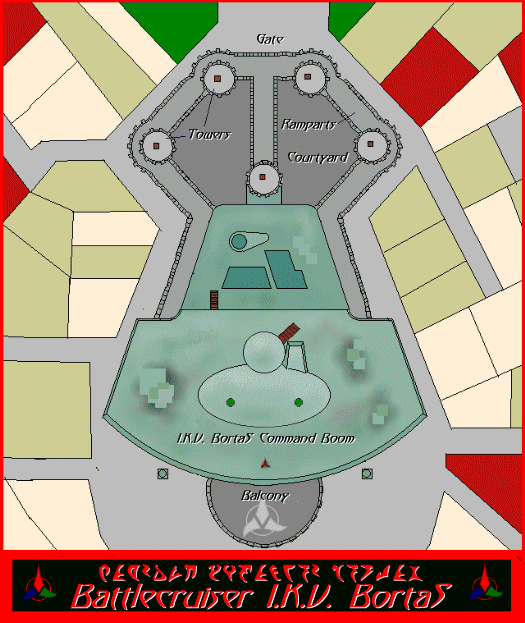 The BortaS' command boom was of standard Klingon design and thus could manoeuvre independantly, therefore the crew were able to land the boom relatively safely. Over the course of the next few decades, a fortification and then a city grew up about the boom. Today, the boom sits at the centre of BortaS City, surrounded by stone walls. Its systems are kept at standby, power provided by hydrogen cracked from local H2O sources. The engineering crew has maintained its numbers at a skeleton crew level using the tutorials and manuals in the ship's library computer. Although poorly trained by modern military standards, they have kept the ship's systems in reasonable working order for over 125 years, an astounding feat by any measure.
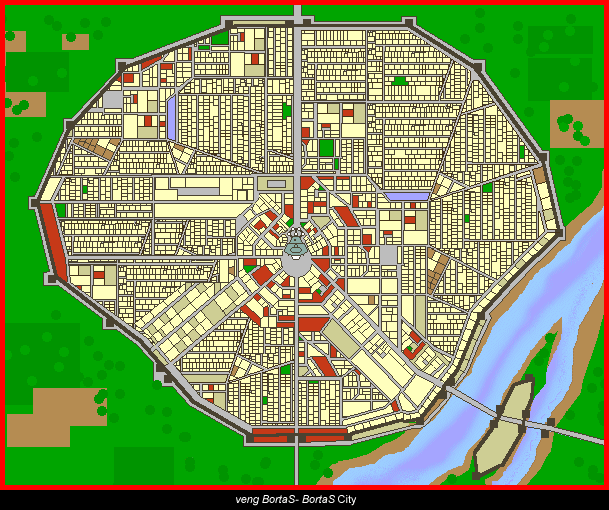 Borta City is a thriving metropolis of several thousand Klingons, descendants of the original survivors. With little in the way of technology, they have created a society reminiscent of their primitive pre-space forebearers in the time of Kahless the Unforgettable. At the centre of the walled city is the central plaza and the BortaS' command boom, flanked by statues of Kahless and HoD Qor'tath. The city is surrounded by 15 metre tall stone walls with a number of guard towers spaced more-or-less evenly along them. The city is roughly round in plan, with radial avenues leading from the central plaza. Buildings are typically Klingon; blocky, slightly tapered masses of stone, wood and stucco with buttresses at the corners. External staircases lead to flat rooves on many of the residential buildings, where much of family life is conducted in the open air. Much of the city uses a relatively low level of technology, comparable to that of 14th century Europe.
 
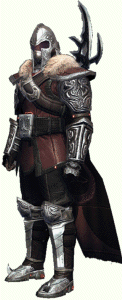  Klingon society resembles that of Earth's ancient northern European medieval cultures. Those born into a ruling family - either a great or minor House - hold more status than that of a commoner. Unlike class systems on other worlds, however, the ability to fight and a willingness to die provides the keys to upward mobility. The commoner who proves himself capable in war could join a House’s army, then through bravery and skill go on to found his own House. A coward or scoundrel, however, will find himself tumbling down the social ladder. The worst receive discommendation - banishment by society. Klingon society generally recognizes four social classes:
Ha'Dlbah: At the bottom of the social order, these are the inhabitants of planets conquered by the Empire. They are expected to serve and support the Empire, by paying taxes and supplying goods and services. Unlike the Romulans, Klingons allow their subjects to keep their own culture, traditions, and political systems, so long as they don't cause trouble. They find it easier to leave the existing social order in place, but make it accountable to Klingon authority. Although not considered property, Ha'Dlbah have no standing in Klingon society. They must obtain permission to move from their local lord or regional governor. They may not own weapons, nor serve in the military. They may not bring grievances against a Klingon, and crimes against Klingons are punished severely. Their lands can be seized without compensation, nor do they enjoy protections against unreasonable search and seizure. Ha'Dlbah who behave, however, have little to fear, and can even gain a measure of prominence. They can not, however, climb the Klingon social ladder. This term means, literally, "dog, cur, inferior person," and Klingons consider it a grave insult.
|







